




If you shop the perimeter at Premium supermarkets, read every annual pesticide residue report, and pay 9 € per kilogram for organic strawberries because you believe the label means chemical-free, there is something the organic produce industry has never told you. It involves the federal definition of “organic.” It involves the conventional farm next door. And it involves why the rinse-and-soak routine most clean-eating households have been doing for years has not been doing what they thought it was doing. Most shoppers assume the word “organic” on a label means the produce was grown without chemicals. It was not. The EU Organic Regulations permits the use of over 25 substances on certified organic produce, including copper sulfate, spinosad, pyrethrin, and sulfur. Several are flagged by the Environmental Working Group for environmental and health concerns. Copper sulfate, used heavily on organic apples, grapes, and tomatoes, builds up in soil and in the produce itself. That is the first invisible exposure: the chemicals organic farmers are allowed to use, that shoppers paying premium prices believe were excluded. The second is geographic. Federal rules require only a small buffer zone, sometimes as little as 7 meters, between organic land and the conventional fields next door. Wind and runoff do not respect that line. Drift from neighboring farm lands on organic crops without affecting the certification. The third is enforcement. The EU Organic inspects most organic farms once a year and tests less than 5% of certified products for actual residue. The label is largely a paperwork certification, not a chemistry one. The fourth is the supply chain. Even the cleanest produce travels through commercial shipping containers, often treated with anti-fungal agents in transit, before it ever reaches the shelf. This is why produce preparation is a real question for clean-eating households, not a paranoid one, and why the limits of standard washing methods are worth understanding. It feels like enough. It isn’t though. The dirt you can see is the easy part. The real problem is what stays on the food after the water is shut off. For example, modern pesticides are designed to be water-repellent on purpose. If they rinsed away in the rain, they wouldn’t protect crops in the first place. So they bond to the waxy coating on every apple, grape, and pepper at a microscopic level. When you rinse, the water beads up and rolls off. The pesticides stay exactly where they were. And this happens with organic produce too, since organic farms are allowed to use over 25 different approved pesticides of their own. Another problem is that bacteria hide where water can’t reach. Pathogens like E. coli, Salmonella, and Listeria don’t just sit on the surface waiting to be washed off. They build tiny protective shields called biofilms and tuck themselves into the pores and crevices of your food. Peer-reviewed research found that rinsing produce under tap water removes 25% or less of pesticide residue, no matter how long you run the water [Hao et al., Journal of Food Science, 2011]. For a household paying premium organic prices specifically to reduce chemical exposure, this is the gap between what is paid for and what is delivered. If you’ve gone past plain water, you’ve probably tried one of the popular home methods. Each has a reason behind it. Each one also has a serious catch. Vinegar. A vinegar soak can knock down some surface bacteria, but only if you leave your produce sitting in it for 10 to 30 minutes. It doesn’t break through biofilms, doesn’t touch most viruses or mold, and doesn’t budge the pesticides that are chemically bonded to the skin. It also makes your kitchen smell sour for hours, and your strawberries and raspberries start tasting like salad. That kind of defeats the point of buying premium berries in the first place. Baking soda. This one is the best of the home methods on paper. A study [Yang et al., Journal of Agricultural and Food Chemistry, 2017] found it outperformed both plain water and bleach at lifting pesticides from apples. But the same study uncovered the catch: Produce sprays. The food industry actually solved this problem decades ago. The same suppliers that pre-cut, bag, and deliver “organic” salad greens to supermarkets and every other major chain use a technology called electrolyzed water to clean produce before it ever hits the shelf. It sounds high-tech, but the idea is simple. Run a low electrical current through water, and you create two powerful, natural cleaners that water alone could never produce on its own. Did you know? The same cleaning chemistry that runs in commercial salad-prep facilities is the chemistry your own body already uses. White blood cells make hypochlorous acid to fight off bacteria from the inside. Electrolyzed water makes it on the outside, in a bowl on your counter. The efficacy of electrolytic purification has been verified by independent laboratory testing. SGS, Société Générale de Surveillance, the world’s leading testing and certification organization, has tested this technology under controlled conditions. 99.8% reduction in Glyphosate residue. This is the active ingredient in Roundup, classified as a probable carcinogen by the WHO’s International Agency for Research on Cancer. 99.9% reduction in Chlorpyrifos. An organophosphate insecticide linked to neurological harm and widely detected on conventional and certain organic crops. 99.9% reduction in surface bacteria, including E. coli, Salmonella, and Listeria monocytogenes. These pathogens are most commonly traced to contaminated leafy greens, berries, and pre-cut salads. The same process applies to the natural-source pesticides allowed on organic produce, too, such as copper sulfate, spinosad, and sulfur. The chemistry doesn’t care whether a pesticide is labeled “conventional” or “organic.” It only cares about the difference between a pesticide molecule and the food itself. And none of this comes from scrubbing. There’s no brush trying to reach into pores, no missed spots around the stem, no waxy patches getting skipped. The entire batch sits in a single bowl and is cleaned evenly through molecular-level oxidation in a single 10-minute cycle. No technique. No effort. No chemical residue left behind. For decades, this kind of cleaning existed only at an industrial scale. The machines were too big, too expensive, and built for warehouses, not kitchens. That has finally changed. The same process has been shrunk down into a small device that sits on your counter. Drop it into a bowl of water with your produce, and it generates the exact same chemistry the commercial food industry has trusted for years. There’s no technique to learn. You fill a bowl with water, drop the device in with your fruits or vegetables, and let it run for 10 minutes. When it’s done, you pour out the dirty water, give the produce a quick rinse, and you’re done. Nothing gets added to your food. No chemicals, no residue, no vinegar smell, no baking soda taste, no mushy berries. This is fundamentally different from the old way of washing. Scrubbing merely pushes contaminants around on the surface, and the brush can never reach the spots where most of them are hiding. Electrolytic cleaning breaks them down at the molecular level, and the chemistry goes wherever the water goes. In clean-eating mothers communities, and the corners of social media where families have stopped trusting the organic premium and started asking what comes next, the same answer keeps showing up: electrolytic cleaning. The story tends to play out the same way every time. A mother who has been reading EWG reports for years, switching grocery chains in search of the cleanest one, and rinsing strawberries under the tap, with that quiet feeling that it isn’t quite enough, finally hears about the technology. She drops the device into a bowl and watches the water turn a dirty yellow-green as she watches over a batch of organic strawberries she just paid eleven euros for. What happens next is almost always the same three emotions in a row. Relief, that something finally does what she thought she’d already been paying for. Anger that the system she trusted for years quietly did not. And determination, that her kids are not going to be the test subjects anymore. The device that keeps coming up across these communities is PuriBreeze “I cried the first time I used it on the strawberries,” one parent wrote in a clean-eating Facebook group. “Not because the water was dirty. Because for the first time in years, I actually knew what was on the food I was feeding my kids. And I knew it was gone.“ Individual results vary, and no device removes 100% of every chemical from every food. What can be said is this: clean-eating mothers who adopt electrolytic purification as their final-step protocol report consistent outcomes. You’d think a technology this powerful would already be all over clean-eating blogs and parenting podcasts. It isn’t, and there’s a reason. When the first wave of cheap produce cleaners showed up on Amazon and Temu, most of them were built on the cheap. They used basic iron or steel parts that slowly corroded during use, turning the water brown with rust rather than anything real. Shoppers saw the brown water, looked it up online, found out it was the device itself falling apart in their food, and walked away from the whole category. Clean-eating writers saw the same thing and stayed quiet on it ever since. But there’s a huge difference between a rusting knockoff and a proper electrolytic device. The good ones use medical-grade titanium parts coated in platinum or iridium, the same materials used in industrial food processing and hospital water treatment. They don’t corrode. The chemistry they create is real, measurable, and lab-certified. PuriBreeze is built to that standard. Medical-grade titanium cell. Independent SGS lab certification. Made in an FDA-registered facility. Those aren’t marketing lines; they’re the actual specs that separate a serious device from the ones that ruined the category’s reputation. It’s the same reason PuriBreeze can do at a fraction of the price what some 189 € competitors do. The chemistry is identical. The difference is in how much they spend on advertising, not on what’s inside the device. The average clean-eating family spends around 400 € a month at Carrefour, Tesco, and similar stores chasing the organic premium. That’s 4,800 € a year. Over five years, 24,000 €. And after all of it, the produce coming through the door is still exposed to the 25+ chemicals allowed on organic crops, the drift from neighboring conventional farms, and the anti-fungal treatments applied during shipping that no label ever mentions. PuriBreeze costs 99.95 €. That’s about a week of what the average family already spends chasing the organic label. After that, every piece of produce in your kitchen, organic or conventional, gets the same lab-verified cleaning before it ever reaches the cutting board. This isn’t really about money, though. It’s about what the money was buying. 83% of clean-eating shoppers say they pay extra for organic because they believe it’s pesticide-free. But it’s not. ⭐⭐⭐⭐⭐ From here, your family really has two paths. One is to keep doing what most households are doing right now. Keep spending 400 € or more a month at supermarkets. Keep hoping the organic label still means what you used to think it meant. Keep rinsing under the tap, and keep reading EWG updates with that quiet knot in your stomach. The other is to stop trusting the label and start handling the chemistry yourself. Give every piece of produce that enters your kitchen, organic or conventional, the same lab-grade cleaning that hospitals and pre-cut salad processors have been using for years. Opting for PuriBreeze is your best shot. It costs less than two weeks of that spending, one time, and handles every piece of produce that comes through your kitchen from then on. Currently, a single unit costs 99.95 € for a limited time. Better yet, bundle deals come with up to 70% off, bringing a single unit down to 79.99 €. One PuriBreeze runs hundreds of cleaning cycles on a single charge and is built to handle daily use for years, so there are no refills and no slow drip of money, unlike vinegar, baking soda, and produce sprays, which quietly add up. If it does not deliver the peace of mind you have been chasing for, you can send it back within 30 days and get every euro refunded with no questions asked. At this discount, the stock moves quickly, and the deeper savings tiers tend to sell out first as more clean-eating households quietly stop chasing the organic premium and start treating their produce at home. Check if PuriBreeze is still in stock >>> As of June 18, 2026* — Ever since PuriBreeze was featured in major health and wellness publications, the response has been overwhelming. Due to its popularity and thousands of five-star reviews, the company is so confident in their product that they are now offering a one-time, first-time-buyer 70% discount. Click here to check if your discount is still available.The Invisible Loophole: What ‘Organic’ Actually Means In Federal Law
The Chemistry Problem With Rinsing Modern Produce
Most of us do the same thing at the sink. Run the water, give the apples a quick rub, maybe scrub the potatoes, and call it clean.Why Vinegar, Baking Soda, and Produce Sprays Fall Short
In other words, baking soda gets outside, but a chunk of what you’re trying to avoid is already in the food.
The bottles at the store are mostly surfactants, which is just a fancy word for soap. The FDA actually advises against putting soap on produce because the porous skin absorbs it. Most studies show these sprays do no better than plain water. And if you’re trying to cut down on chemicals, spraying on another chemical isn’t really a step forward.
Switching grocery stores.
This one feels like a real option but it isn’t. premium supermarkets, Carrefour, Tesco, and Lidl all source from the similar networks of certified organic farms governed by European Union regulations that permit 25+ chemicals and accept drift contamination. The label on the package is identical because the underlying agriculture is identical.The Industrial Standard Already Used By Supermarkets’ Own Suppliers
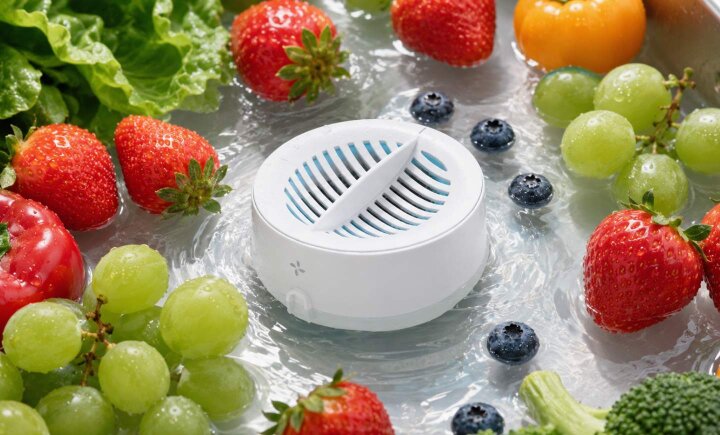
Here’s the part most shoppers don’t know.
Two things get produced in the water, and each one handles a different problem:
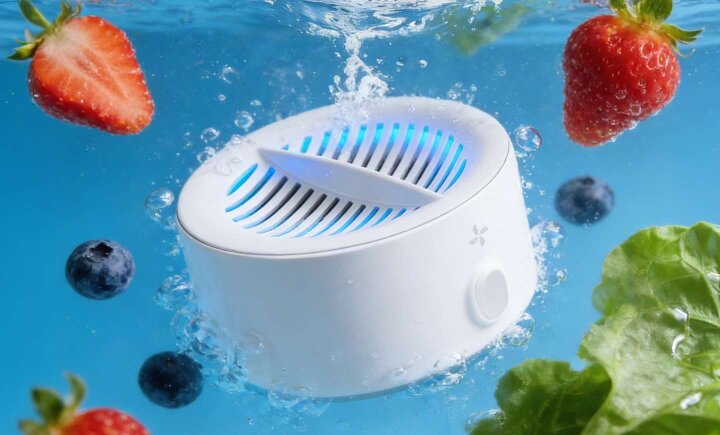
On top of that, the process creates tiny micro-bubbles that slip into the pores and crevices of produce. That’s how the cleaning reaches the spots a brush or a rinse can never touch.
A 2011 study from China Agricultural University found that electrolyzed water removed 59-86% of pesticide residues on spinach, beating both tap water and commercial detergents in every test. Vitamin C levels stayed intact, so the nutrition you’re paying for stays in the food Hao et al., Journal of Food Science, 2011.
A 2024 study tested the same technology in home countertop devices. It confirmed strong reductions in pesticide levels across a wide range of produce [Molecules, 2024].
In other words, this isn’t a new idea. It’s the industrial standard, now small enough to sit on your kitchen counter.What Independent Laboratory Testing Shows

The verified results for high-grade electrolytic purifiers include:From Commercial Salad Bars To Your Kitchen Counter
How Health-Conscious Mothers Are Using This
What Mothers Report After Switching
Why This Technology Is Only Now Reaching European Households
The 4,800 € Wake-Up Call

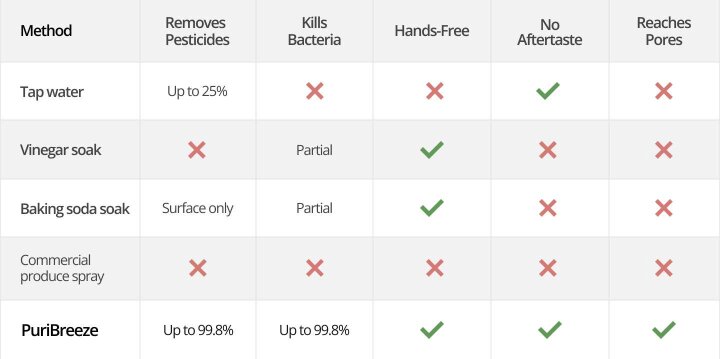
PuriBreeze is what closes that gap, once and for all.
“I’d been buying organic for six years. Spending probably 400 € extra a month on it because I have two kids and I wanted to do right by them. Then my sister-in-law sent me an article saying organic still uses approved pesticides and I went down a rabbit hole at midnight reading about it. Bought PuriBreeze that night honestly out of spite. Tried it on the organic apples I had in the fridge from Supermarkets, and the water turned a kind of dirty yellowish brown and I just stared at it. These were the expensive ones. The ones I felt good about buying. I still buy organic for some things but I treat everything now, organic or not, and I’m not pretending I don’t know what I know anymore.“
— Emma R., mother of two, Amsterdam
⭐⭐⭐⭐⭐
“My husband thought I was being ridiculous. He’s the kind of guy who eats apples without washing them and says his stomach is fine. I made him watch the first cycle on a batch of grapes from Coop 365. He didn’t say anything. Just looked at the water and walked out of the kitchen. Later that night he asked me if I’d done strawberries yet. I have not heard him say a single thing about me being paranoid since. I think the worst part for him was that the grapes were the ones he’d been eating straight out of the bag for months“
— Freja, mother of three, Copenhagen
⭐⭐⭐⭐⭐
“I’ve always been the ‘read every label, check every batch’ kind of parent. Organic or conventional, I worried about pesticides. A friend recommended PuriBreeze, and I was skeptical. Then I tried it on some organic blueberries. The water turned yellow, and I felt both grossed out and relieved. It was proof that I hadn’t been doing enough. Now, I use it on everything — it’s fast, it’s simple, and I finally feel like I’m doing right by my family. I even brought one to my parents’ house so they could try it too. We all sleep better knowing our produce is cleaner.“
— Sophie, mother of three, DublinHow Much Does PuriBreeze Cost?




 Like
Like Comment







Customer Ratings
Average based on 9,803 reviews
 Excellent


